All posts by Dave Parker

Poverty and the Kalahari Bushman: Advancing the Conceptualization of what it means to be poor.

Poverty and the Kalahari Bushman:
Advancing the Conceptualization of what it means to be poor.

By D.A.Parker

Introduction
The purpose of this literature review is to gain a fuller understanding of the current debate and views on conceptualising poverty in the contemporary world.
The first part of this paper explores the development of the Orshansky Threshold leading up to the creation of the dollar a day poverty line the standard measure of poverty promoted by the World Bank. In the next section, the paper contrasts this approach with the constructivist approach of Sen and the development of his entitlement theory.

Part two examines the plight of the Kalahari Bush and assesses the usefulness’ of both these theories. And finally in conclusion suggest where things could be improved.

The Orshansky threshold
Two approaches are evident in the poverty debate today. The positivist approach favoured by Dollar and Kraay of the World Bank, described as lacking rigor by Sumner (2004), usually relies on ‘large scale random sample households surveys, with a preferences for consumption expenditure over income, as being more stable over time’ (Wrattern, 1995 cited,Moser,2003 pp114:Woollcock, 2007,pp01). The roots of this approach can be traced back to the advent of the ‘Orshansky threshold’ (Barrington,1997).

In 1963 Mollie Orshansky [1915 – 2007] created the ‘seminal US poverty line’ (Barrington 1997, p. 1) that has since become known as the Orshansky threshold. The Orshansky threshold is a poverty base line that relates to a basket of goods commonly consumed by the average non farming family household in America (Barrington,1997).

This basket has a Dollar value that is multiplied by three to give the minimum income needed for survival, of the average family in America in times of crises or food shortages (Hauver, et al., 1981). This system was later adopted by dollar and Kraay and modified to fit the developing world, which led to the creation of the dollar a day; the standard measure of poverty favoured by the World Bank. The data Mollie used to create this system was taken from the US department of agriculture who had gathered the data on nutrition and consumption for an emergency food plan (ibid).

The ineptness of this measure is clear to see in this extract from the New York Times (2003) ‘In Vietnam a dollar buys half a pound of rice, half a pound of potatoes and a third of a pound of ground beef’ reported Daniel Altman (2003) of the New York Times, ‘In Mexico a dollar buys a pound of rice, a pound of beef and, half a loaf of bread’ (ibid). Because of unequal distribution the buying power of the dollar can vary considerably.

Yet For the World Bank and the United Nations and many other Neo-liberal thinkers this dollar is the dividing line between being rich or poor suggest Altman (2003). However, it is easy to see from this report that in the real world it has little value in real terms.

The second approach that is prevalent in the poverty debate is the ‘Narayan approach’ (McGregor and Cantley,1992) of the constructivists favoured by Amartya Sen et al (1999) and Andrew Sumner (2004) this viewpoint ‘rejects the income/ consumption perspective as being too narrow and reductionist, serving the technocratic needs of development professionals, rather than seeking to understand the complexities and diverse local realities in which the poor live’(Chambers 1995, cited Moser 2003, p. 114).

Amartya Sen is one of the most influential thinkers in the field of development today has developed his ‘Entitlement theory’ (Sen, 1981: Sen. and Drèze, 1999) out of his study of famines both in India and Africa and born through his whish to improve conditions in his home country India. Whilst working for the United Nations Development Program he was instrumental in creating the human development index that was adopted by the UNDP in 1990 (Noorbakhsh,1998).

The change in debate that has taken place over the last decade centres around two main approaches to the conceptualisation of poverty as identified by Maxwell (1999). These approaches being the quantitative approach favoured by the World Bank and David Dollar, that recognises ‘income and consumption patterns as the as the best proxies for poverty’ (Moser 2003) and the qualitative, a more humanistic approach (Moser and McIlwaine, 2003, pp. 114-115). This approach takes into consideration basic human needs, rights, freedoms as well as considering access to entitlements and opportunity (Sen 1981). ‘Both systems use multiple subjective indicators of poverty status’ (Moser and McIlwaine, 2003).

This change in thinking has been heavily influenced by Sen’s work has led to the creation and adoption of the Millennium Development Goals. This represents an important shift away from the static poverty lines approach, moving towards an approach that recognises the ‘multidimensionality of deprivation though the analysis of assets and vulnerability’ (Moser, 1998; Maxwell, 1999).

Development and Freedom
In his book Development as Freedom Sen argues that ‘freedom is the both the primary end and the principle means of development’ (Sen, 1999, p. 31) taking this stand point Sen argues that the developing world suffers from various forms of un-freedom that restrict the process of development, this traps them in to cycles of development and un-development.

This concept is repeated in Professor Colliers (2007) book The Bottom Billion in which he argues that, for the bottom billion developments is likened to a game of snakes and ladders with the rules slightly changed hence, ‘Snakes & chutes’(Collier 2007; pp05) meaning there are considerably more ways down than there are up.

Both Sen (1999) and Collier (2007) would argue that the economic division between the rich and poor is increasing and for the people in the bottom billion, conditions have not improved much over the last decade. These people in the bottom billion are getting left behind because they are stuck in cyclic poverty traps.

Utilitarianism
In contrast to this the institutional concept of poverty expressed by Dollar and Kraay (2002) appears very different. The neo-liberal view of the World Bank as expressed by Dollar and Cray (2002) see the undeveloped world suffering in a ‘low-equilibrium trap’ (Nelson, 1956). This means that the capital stock accumulation is raising at the same rate as population growth, thus, income per worker is not increasing meaning zero per capita growth, the economy suffering from stagnation and zero economic growth (Nelson, 1956).

Not withstanding this trap David Dollar (2002) argues that the poverty gap is not increasing but decreasing with integration in the global economy. He argues that this is spreading of the wealth, a kind of trickle down affect. He goes onto suggest that it is only a matter of time before the rest catch up. He leans heavily on China for statistics to back up these claims.

The utilitarian approach of Dollar and Cray uses hedonic calculus when obtaining and manipulating data statistics. This limits itself by being concerned only with the sum-total and does not included minority or individual sufferance (Sen 1999).

There appears to be general consensus among ‘scholars and practitioners alike that the causes, manifestations and consequences of poverty are multidimensional’ (Sen 1999: Cited, Woolcock 2007, p. 1), meaning that poverty can not be defined by income alone. Although there appears some agreement between the constructivists and the positivists in that they both see poverty as multi-dimensional however, it is the nature of these dimensions that is at question.

Poverty and the Kalahari Bushman
So far this paper has examined conceptual theories that assume the standard classical economic model as conditions or preconditions required for integration into the capitalist economic system. None of these concepts discussed so far has catered for populations that choose to live outside of this system.

There have been several failed attempts to integrate the Bushman of the Kalahari into the modern world. Guenther (1977) writes of the rich white farmers of northern Botswana, who inhabit vast areas of the most fertile land in the country. The white people acquired there land around the turn of last century from the Bantu-speaking Tawana. Prior to the Tawana settlers the land was inhabited solely by the San Bushman the Tawana laid claim to the land and sold it to white settlers with no consultation to the San people. Historical evidence shows that Bushmen communities have always lived in the desert regions of the Kalahari.

The early attempts by the new settlers to employ the Bushman as farm workers all but failed from the outset. The Bushman are a nomadic people and never stay in one place for to long. Also the low wages that the new settlers paid the bushman meant that they had to supplement there income with hunting. Often after a hunting trip they would return to find no jobs as the farmer would have employed a new group of workers. Thus the cycle begun again with the new group, they never stayed long enough to learn the skills required to work on a farm (Guenther,1977).

This was the first attempts to integrate the Bushman hunters in to modern society. Unsurprisingly they clearly had no inclination to adopt a settled life style and the conditions offered by the white farmers where far from favourable they had a much better opportunity remaining as they were.

The San are but one of a number minority groups in Botswana and represent a relatively small proportion of the total population. Accurate data of the precise numbers are hard to find, with figures varying from as little as 3% (Hitchcock, 2002) up to 10% (US Bureau of African Affairs, 2007).

The people of the Kalahari have survived forced removal from there lands and found themselves for the first time in there history suffering the inflictions of modern life. Survival International reports that for the first time they now have Aids and other sexual transmitted dieses in the community and many are becoming alcoholics, inflictions that have never been seen by these people before (Survival-international 2008).

Poverty has finally overcome these people ‘In many ways, they are at the bottom of the Botswana socio-economic system. A sizeable proportion lives below the poverty datum line. They exhibit some of the highest rates of infant mortality alongside the lowest living standards and literacy rates, and in many cases have insecure access to land and resources’ (Hitchcock, 2002). Over the years the Kalahari Bushmen have remained in poverty where their richer neighbours denied them rights to the land, in both Botswana and Namibia, they have found their territory drastically reduced.

Most livelihoods approaches such as Sen’s ‘Entitlement theory’ (Sen,1981) tend to focus on economic and social aspects rather than physical dimensions such as personal safety. The concept of security itself is mostly associated with national and international territorial disputes’ only recently have there been efforts to broaden this to incorporate notions of human security focusing on basic needs and human dignity (United Nations Development Programme (UNDP), 1994: World Bank, 2000) perhaps this why tribes like the Bushman are getting left behind. Simply there is no system that caters for their specific needs.

There has been renewed attempt recently to bring the bushman into the modern world. The self stared NGO, The first People of the Kalahari, (TFKG) set up by the san peoples in order to unify and take control of the Bushman’s knowledge and fight for land rights as well as control their wealth. With the discovery in 2002 of a plant that helps combat obesity and only grows in the Kalahari Desert region, suddenly there knowledge is of some value and attempts are being made to profit from it. Coincidently Shiva Vandana has been advocating saving and protecting indigenous cultures for many years for this very reason. In order preserver diversity it is the indigenous people who hold the key, suggests Shiva (Shiva,1991).

Another attempt to integrate the Bushman them into the economy is being made by the organisation for Information and communications technologies for development (ICT) a subsidiary of the NGO Development Gateway Foundation, who suggest that the ‘Kalahari Bushmen, have become a depressed and marginalised community, excluded from their traditional nomadic range by the good intentions of those who have fenced it into national wildlife parks in which there is no place for humans, and certainly no place for those who treat these preserves of endangered species as a larder. In the past the San people’s understanding of their environment was everything they needed, but as the fences went up, that understanding became irrelevant; they lost everything and fell into poverty’ (ICT 2003). Suddenly their knowledge is of value.

Conclusion
Although there has been a lot written about the Bushman of the Kalahari, however, there is little actual evidence to be found of the extent of poverty in which they live. The reason for this must partly be because they have lived predominantly outside of the economic system. Concomitant with this the attitude of the Botswana Government has not provided for a fair assessment of the situation.

Until recently they have been consider to have no economic value other than a tourist attraction. In fact on the contrary the government has viewed these peoples as a hindrance to development and in the way of progress and diamond extraction.

This study clearly shows the need for a way of measuring the extent of poverty that these peoples endure. The pressure of modernisation and development are forcing these people into lives of hardship and poverty as before they have never seen or experienced.

Recent events with the discovery of medicinal plant that can be used in the west high lights the need to preserver these people’s knowledge customs, as well as showing their economic worth. 80% of all medicines know today originated from plants out of the rainforest and have used by indigenous tribes foe centuries (Shiva, 1991).
This paper has highlighted’ a gap in the thinking of economic theorist when it comes to conceptualising the poverty of indigenous populations. The systems that they conceptualise do not on the whole, consider the indigenous culture that live out side of the normal economic system; this paper has also shown the reason why we need to include these people in the poverty calculation.

The constructivist approach of Sen is the closet tool available to measure the poverty of these people. This approach needs to be expanded so that measuring the depth of poverty of indigenous culture that live outside the system can be achieved.

References
Barrington, L. (1997) Estimating Earnings Poverty in 1939: A Comparison of Orshansky-Method and Price-Indexed Definitions of Poverty. The Review of Economics and Statistics, 79 http://links.jstor.org/sici?sici=0034-6535%28199708%2979%3A3%3C406%3AEEPI1A%3E2.0.CO%3B2-J

Guenther, M. G. (1977) Bushman Hunters as Farm Labourers. Canadian Journal of African Studies / Revue Canadienne des Etudes Africaines, 11 http://links.jstor.org/sici?sici=0008-3968%281977%2911%3A2%3C195%3ABHAFL%3E2.0.CO%3B2-I

Hauver, J. H., Goodman, J. A. & Grainer, M. A. (1981) The Federal Poverty Thresholds: Appearance and Reality. The Journal of Consumer Research, 8 http://links.jstor.org/sici?sici=0093-5301%28198106%298%3A1%3C1%3ATFPTAA%3E2.0.CO%3B2-1

Hitchcock, R. K. (2002) ‘We are the First People’: Land, Natural Resources and Identity in the Central Kalahari, Botswana. Journal of Southern African Studies, 28 http://links.jstor.org/sici?sici=0305-7070%28200212%2928%3A4%3C797%3A%27ATFPL%3E2.0.CO%3B2-V

Maxwell, S. 1999: The meaning and measurement of poverty. ODI Poverty Briefing
, London: Overseas Development Institute http://www.odi.org.uk/briefing/pov3.html; (accessed3 December 2002)

Mcgregor, P. & Cantley, I. (1992) A Test of Sen’s Entitlement Hypothesis. The Statistician, 41 http://links.jstor.org/sici?sici=0039-0526%281992%2941%3A3%3C335%3AATOSEH%3E2.0.CO%3B2-6 (Accessed 10/09/2007)

Moser, C. O. N. & Mcilwaine, C. (2003) Encounters with Violence in Latin America : urban poor perceptions from Colombia and Guatemala, London, Routledge.

Nelson, R. R. (1956) A Theory of the Low-Level Equilibrium Trap in
Underdeveloped Economies. The American Economic Review, 46 http://links.jstor.org/sici?sici=0002- 8282%28195612%2946%3A5%3C894%3AATOTLE%3E2.0.CO%3B2-O

Narayan, D. 1997: Voices of the poor: poverty and social capital in Tanzania.
Environmentally and Socially Sustainable Development Studies and Monograph Series 20, Washington DC: World Bank.
Noorbakhsh, F. (1998) A Modified Human Development Index. World Development, 26 http://www.sciencedirect.com/science/article/B6VC6-3T0T9BG-C/2/382ebf5db99a79091602844392bc903e

Woolcock, M, 2007 Toward an Economic Sociology of Chronic Poverty:
Enhancingthe Rigor and Relevance of Social Theory, CPRC Working Paper 104. Brooks World Poverty Institute University of Manchester Humanities, Bridgeford Street, Manchester M13 9PL. http://www.chronicpoverty.org/pdfs/104Woolcock.pdf

Sen, A. (1981) Poverty and famines : an essay on entitlement and deprivation, Oxford, Oxford University Press.

Sen, A. & Drèze, J. (1999) The Amartya Sen and Jean Drèze omnibus : comprising, Poverty and famines, Hunger and public action, India: economic development and social opportunity, New Delhi ; New York, Oxford University Press.

Shiva, V. & World Rainforest Movement. (1991) Biodiversity : social & ecological perspectives, Penang, Malaysia, World Rainforest Movement.

Other Online sources used
ICT 2003 on line at http://topics.developmentgateway.org/ict/sdm/previewDocument.do?activeDocumentId=571778#top (accessed 02/2008)
The US State Department, Bureau of African Affairs (2007) available at,
http://www.state.gov/r/pa/ei/bgn/1830.htm (accessed 10/05/2007)
Minutes of the Panel Meeting on Global Poverty Measures and
International Comparisons (New York, Tuesday, 3 February 2004 – 10:00 a.m. to 1:00 p.m.) http://unstats.un.org/unsd/methods/poverty/minutespanelmeetipdf

Trade, Growth and Poverty in the developing world.

Trade Growth and Poverty In the developing world

By D.A.Parker

Introduction

When considering Trade in today’s economically integrated world, it is important to consider the terms of trade (TOT) as a primary concern. The TOT defines the nature of trade and controls the direction of benefit. This paper will examine and evaluate the conditions of trade, imposed upon the developing world and assess the usefulness and effectiveness, of global TOT, towards poverty reduction and growth.

The Global market an unequal opportunity

Countries that have integrated in to the Global economy have experienced rapid growth over a sustained period and have considerably reduced poverty along the way. It would appear obvious, that if these countries should be able to adapt to the global market that there would be no reason why another country could not do the same. Unfortunately, however, many undeveloped nations do not have the technological know-how, infrastructure or political and economical policies to warrant competing in the first place. Along with these conditions many LDC face fiscal inadequacies, burden of debt, trading restriction and structural adjustment policies (SAP) enforced by donor countries and financial institutions, that restrict the growth and development of low income countries, e.g. the World Bank and the IMF. According to Schuurman (1993) the problem of introducing the developing World into a ‘World System’ is that “underdevelopment occurs in countries that are subject to trading in an unfair, unequal, ‘world-market’, where high trading tariffs and restrictions are imposed”.

TOT (Terms of Trade)

Diminishing returns and unequal exchange, clearly the developing world is in deep trouble. On One-hand the Neo-Ricardian economist struggle with exchange and barter value, in an ever changing commodity market, with fluctuating prices and import deficits, concomitant with Neo-liberal growth centered capitalist, pushing for trade liberalisation and a free market to exploit.

Free Trade ISI and SAP

Considering the juxtaposition presented by the Brant and Berg reports, which came out of Bretton Woods; it became obvious that a compromise in principle was needed when considering ‘Third World Development’ (TWD). The problem is that post war modernisation economist and capitalist governments’ rejected any kind of state intervention as this conflicts with free market ideology and was considered socialist.

Introduced by Singer (1950) the IMF offered the solution, in the form of “Import substitution, industrialisation” (ISI) (Begg & Fischer et al, 1991:639); ISI could be considered the fore runner – or ancestor – of structural adjustment policies (SAP), What ISI meant, was that the capitalist governments could manipulate and control the industrial development process of the TW countries, in order to suit their own economies.

Consequently subsidisation of favoured industries, led to heavy investment in some sectors, whilst, stunting growth or closing, other sectors of the economy; whilst maintaining control over export and import, tariff’s and taxis (see 1991). The ‘Developing World’ entered an era of dependent industrialisation, only obtaining economic favour from the west as long as they kept to capitalist ideologies and vagary.

TW industrialisation, along with the change from food to cash cropping in agriculture, has increased reliance on importation of food and other basic essentials exponentially. The industrialisation process also means that they have become increasingly reliant on energy importation for fuel and power (Beaud M, 2000: 290-301). “The increasing reliance of the TW on the west can be clearly observed, through study of the modernisation process” (Kiely R 2003).

Results of unequal Trade

A recent World Bank report (2007) on trade in Africa clearly shows the failing of liberalisation and trade policy in the African continent. The report states that, “Over the past three decades Africa has become ever more marginalized from trade at the global level” (ibid). “Africa’s share of world exports has dropped by nearly 60 percent, a staggering loss of $70 billion annually, equivalent to 21 percent of the region’s GDP and more than five times the $13 billion in annual aid flows to Africa” (ibid).

Solutions or Problems

Dependency theorists such as Frank and Prebisch would suggest nationalisation to hold back the flood of multinationals and encourage local business and industries. To support this nationalisation they suggest high import tariffs and control of exports along with tight foreign exchange policy; remarkably similar to ISI imposed by the IMF after Bretton Woods.

Reinforcing the opinion that state intervention is beneficial for struggling LDC economies, is a study undertaken by Steve Dowrick and Dr Jane Golley (2004) entitled, Trade Openness who Benefits? In order to assess the validity of a report by Sachs and Warner, on the benefits of free trade, it interestingly uncovers that, “free trade has no effect on developed economies, negligible if no effect on less-developed economies, and a negative affect on undeveloped economies” (2004). This seemingly backs up the argument for dependency theorists such as Frank and Prebisch who say suggest that free trade is bad for TW development. The other side to this argument is the opinion that growth of industrial development has brought nothing but “hostility, suffering and dehumanisation too many along with rapid urbanisation and poverty. The unequal division of wealth created by nationalist doctrines in order to protect and enhance the nation states power and independence [can only create more poverty]” (Kitching, 1982) .

The right conditions

Having the right conditions for trade to be effective towards poverty reduction is clearly the key, but then the questions must be asked, what are the right conditions and can they be created? Ghatak (2003) argues that, “if free trade does not allow a countries true comparative advantage situation to develop, owing to the difference between marginal social and marginal private cost, then trade should be temporarily protected during its initial high cost period” (2003;193), or until, “specialisation is established” in the international economy. This is the same route that many of the successful Asian Tigers have used to gain comparative advantage in the world market. Ghatak (2003) goes on to express that in order “to increase social welfare the infant industries must grow up to be able to compete on equal terms with foreign producers in domestic and world markets” (2003;193). This concept should be applied both locally and nationally and across the entire African continent and other LDC, for trade to be of any benefit towards long term poverty reduction on a global scale.

Free Trade & Liberalisation

The conditions for effective trade are according to Ha-Joon Chang trade policies that are “based on neoclassical trade theory: Free trade promotes the optimal allocation of resources” according to Chang “except when a country has a monopoly in trade” (Chang, 2004: 292). These assumptions Chang argues are, “based on stringent assumptions”, including “identical technologies across countries a ‘well behaved’ production function, full information, no learning cost and no risk” (ibid), these assumption are clearly false when considering present day conditions in the developing world; the problem of trading on these terms has got to severally hinder growth and poverty reduction throughout the developing world.

Does trade reduce poverty?

In 2005 the UNDP reported that 1 billion people in the ‘Third World’ are living on less than $1 a day, today’s conditions are not much different. The millennium goals for development and poverty reduction proposed by the World Bank and IMF appear to be helping somewhat, though clearly, there is still along way to go, (see fig 1).


“The global politics of trade” – therefore TOT- according to Preston (2005) are “conducted wholly within the framework of the WTO” (2005:196). Consequently the policy that these organization pursue are heavily influenced by TNC and multinational corporations.


David dollar and Aart Kraay (2001) of the World Bank in their report on Trade Growth and poverty, report that, “A key issue today is the effect of globalization on inequality and poverty” they go further to state that “evidence from individual cases and from cross-country analysis supports the view that globalization leads to faster growth and poverty reduction in poor countries” (2001). This contradicts findings made by Oxfam expressed in their paper entitled Rigid Rules Double Standards (2002) in which they clearly show that free trade liberalisation without tariffs and controls severely hinder growth of poor countries whilst subsidisation and tariffs have shown to be beneficial to underdeveloped economies (Oxam,2002: chp 3). The report goes on to show that globalisation and free trade has in some cases increased poverty despite apparent Growth (2002.chp 9), undermining that there is no apparent link between growth and poverty reduction.

Conclusion

It is seemingly clear and well understood that trade is good for growth. However, evidence would suggest that this does not necessarily mean that poverty reduction will automatically follow. The problem of poverty reduction is more complicated than just jumping into a global market. The Asian Tigers such As china and North Korea, have shown that it takes time, careful planning, and control to be successful in the global market. Trade done properly and fairly under the right conditions can be beneficial to poverty reduction. On the other hand if the rules are unfair or not followed trading in the global economy can only bring further poverty and growth reduction.


Bibliography

Dorwick S & Golley J (2004) Trade openness and Growth: Who Benefits, available at http://oxrep.oxfordjournals.org/cgi/reprint, also available on the Athens web, accessed on 10/04/2007.

Dollar D Kraay, (2002) Trade Growth and Poverty, available at,

http://rru.worldbank.org/Documents/PapersLinks/442.pdf, accessed on 12/04/2007.

Ghatak, S, (1995) Introduction to Development Economics, Industrialisation, Protection and Trade Policies.

Ha-Joon Chang (2001) Rethinking Development Economics, Wimbedom publishing company, London.

Kiely R, (2003) Sociology and Development, The Impasse and beyond, Routledge, 11 New Fetter Lane London EC4P 4 EE.

Kitching G. N, (1982) Development and underdevelopment in historical perspective populism, nationalism, and industrialization. London, New York, Methuen.

Oxfam (2002 ) Rigid Rules Double Standards, available at http://www.maketradefair.com/en/index.php?file=26032002105549.htm,acessed on 10/04/2007.

Payne, A. (2005) The Global Politics of Unequal Development,

Schuurman F J (2004) Beyond the impasse, zed Books Ltd London.

World Bank (2007) Trade, available at
http://web.worldbank.org/WBSITE/EXTERNAL/COUNTRIES/AFRICAEXT/EXTAFRREGTOPTRADE/0,,menuPK:502475~pagePK:34004175~piPK:34004435~theSitePK:502469,00.html

World Bank (2002). http://rru. org/Documents/PapersLinks/442.pdf
http://siteresources.worldbank.org/INTGDF2002/Resources/FullText-Volume1.pdf

Foreign direct Investment and poverty reduction By D.A.Parker

Introduction

In order to assess whether Foreign Direct Investment (FDI) has been good for poverty reduction or not, this paper will use Botswana as a micro illustration were FDI has been considered successful. FDI in Botswana has effectively contributed towards increased per capita gross domestic produce (GDP). The example used, shows continued growth and a stable economical climate over a number of years, and has attracted good FDI. This coupled with a sound reinvestment program has stimulated Botswana’s economy into being one of the most secure reliant investment opportunities within the SADC region (southern African development council).

This paper will go on to show that it takes more than FDI to reduce poverty, whilst simultaneously highlighting the fact, that the way we measure poverty, based on one dollar or two dollars a day, is in fact inaccurate. The second section of this paper will use Vietnam as an example, to demonstrate the difficulties faced and the often poverty generating policies, that pre-industrial or semi-industrialised countries use in attempts to create the right economic environment to attract FDI into the country.

A success story: FDI and Good Governance

  There are several unique factors that enabled the success of FDI in Botswana; Firstly Botswana had a clear social good governmental policy in place prior to investment. The government was dedicated to a fully democratic system of rule with a just and fair legal system. What makes Botswana’s system unique is, the incorporation of the House of Chiefs, to represent the clearly demarcated wards within the country and consider the existing tribal heritages and land ownership rights. However, until recently this did not include the indigenous population living within the Kalahari Desert region.

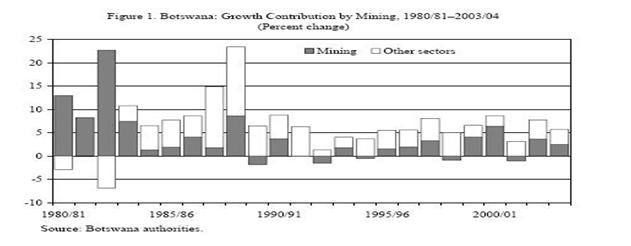
Since independence in 1966 Botswana’s policies have created a stable and attractive investment climate, for would be investors. Subsequently when diamonds of quality were discovered in Botswana, a mutually beneficial and fair (FDI) opportunity was created, leading to the formation of The De Beers Botswana Mining Company on 23 June 1969 (De Beers Group, 2007 a). In 1991 the company changed its name to Debswana, which is owned in equal share by the Government of Botswana and De Beers Centenary AG (2007a). Botswana has enjoyed uninterrupted economic growth and soaring per capital incomes in most years since diamond mining began in ‘1971’ (2007a). The diamond industry transformed Botswana from an agriculture-based economy to one in which diamonds account for ’80 percent of exports and 50 percent of government revenue (see fig1). By value, Botswana is the largest diamond producer, in the world; Debswana produced approximately 28,4 million carats in 2002 (ibid).


Figure 1 (source, IMF: 2006)

Sir Seretse Karma, the first president of Botswana laid the foundation of a moral socially conscious government that has a zero tolerance policy towards corruption, along with a sound Development policy. Botswana is now the leading African state that has never had a war or been victim to political violence or upheaval. The country is presently positioning itself to be the “Banking and Finance centre for African investment” through the creation of the ‘Botswana international finance service centre’ (2007b) and the ‘Botswana stock exchange’ (IFC 2007C www.ifsc.co.bw).

The Botswana exemplar proves that by creating the right climate for investment to happen, along side a sound governmental policy and a solid development strategy, Concomitant with, the will to reinvest and allow the local economy to grow organically, growth will follow. This example offers a glimmer of hope and sets a precedent for the rest of sub-Saharan Africa to follow. However, the unique position Botswana found it self in after independence in 1966, most certainly gave the country a comparative advantage. ‘Debswana’s mining operations have been chiefly responsible for transforming Botswana from an agriculturally based economy in the 1960s to a country that has subsequently and consistently displayed one of the highest economic growth rates in the world’ (DE Beers 2007a: Bureau of African Affairs ,2007b)

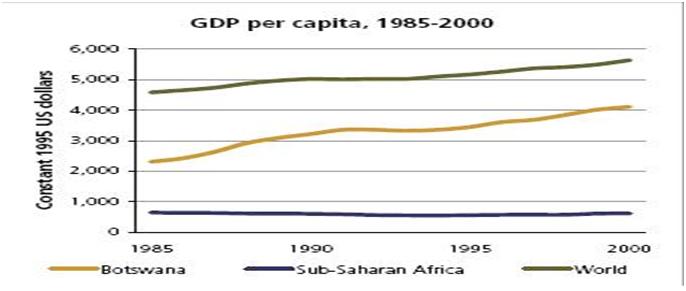
The per capita GDP of Botswana has been growing at a steady rate since diamonds were discovered (see fig 2). The US sate department (2007b) places Botswana ‘per capita nominal GDP in 2004/5 at $5,336’ (Bureau of African Affairs, 2007b). This clearly shows that the right climate can attract investment, this together with a comparative advantage and a sound reinvestment policy a can improve per capita GDP, but, does this mean that poverty has consequently been reduced?


Figure 2 (source Earth trends 2003)

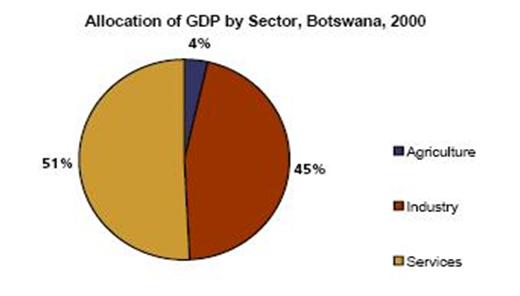
Along side the diamond industry, the Botswana government has been following a strategy to diversify their economy (see fig 3). To date there are over 22 FDI investors. Theses include the U.S. Overseas Private Investment Corporation, performing methane extraction, BCL running the Soda Ash operations and in other sectors, Kentucky fried chicken running franchises, Hyundai by direct FDI, H.J. Heinz direct FDI, Volvo Trucks & busses, international private company, to name but a few of the investor in the country (2007b: goliath.2007d).


Figure 3 (source earth trends 2003)

Despite all this FDI and growth according to world standards, Botswana still has an unacceptable amount of people living in poverty or relative poverty. According to Earth Trends (2003: p2) the percentage of the population living on less than a $1 a day in Botswana is ‘33%’ (2003) and ‘61.4 %’ on less than $2 a day’ (ibid). Assuming these figures are correct, clearly Botswana’s money is not making it into the majority of the population’s pockets. Why is it that, after almost thirty years of independence approximately ‘64%’ (2007b) of the population remains in so-called poverty? Perhaps we should consider the demographic make up before we attempt to answer that question by normative dollar a day calculation.

It must be considered that the people of the Kalahari, (excluding the Tswana), the Kalanga, Kgalagadi, Herero, Bayeyi, and Hambukush – some of whom have fought over a 20 year long, court battle to be able to return to the desert after being banned from their land due to mining activities. These people represent the traditional inheritors of Botswana; a view the current constitution strongly apposes. These people of the desert, who choose not to be in the towns or cities, having little need for a dollar a day and very little interest in industrialisation, collectively account for around an estimated 11% of the indigenous population. These people along with the traditional cattle herding communities, who incidentally consider cow more valuable than money and who collectively account for around 40% of the population (2007b), represent 51% of the population that live in the rural regions of the country.

The US State department states that that ‘More than one-half of the population lives in rural areas and is largely dependent on subsistence crop and livestock farming. Agriculture meets only a small portion of food needs and contributes a very small amount to GDP – primarily through beef exports – but it remains a social and cultural touchstone. Raising Cattle dominated Botswana’s social and economic life before independence. The national herd is estimated between 2 and 3 million head, however, the cattle industries are experiencing a protracted decline’ (2007b. This seemingly supports the figures quoted earlier this paper. For some of these people, the choice is to live rural lives. The city is often not far away and there is work, thanks to FDI and good governance. However, they choose to stay on the cattle post or wander the desert, and, when considering PPP, two dollars a day would be more than adequate for some of these rural communities. In Botswana ‘literacy rate is ‘80%’ (2007c: 2007b) so choice is almost certainly the reason for staying on the cattle post not ignorance. With all these factors in mind, should all these people still be considered to be living in poverty and therefore be included in the poverty calculation based on a dollar a day? Or should the poverty calculations include and value alternative ways of living?

The Disadvantages

The myth of the trickle down effect: FDI and the increasing poverty gap

The trickled down effect is a presumptuous theory that does not happen. Invented by classical neo-liberal economist, indisposed to admit that it is a sham. What is well known to economist is that as wages increase by one percent, spending increases by only a half of a percent, so trickle down is virtually non existent,. Ricardian economists call this diminishing returns. Similarly, FDI brings fiscal wealth into the economy; this has an affect of bringing about a wider variety of imported goods to local market, corresponding with the increase in wealth and consequent liberalisation. The effect this has on the economy is that the imported goods compete with locally manufactured goods. What is often the case is that, the imported goods are cheaper than locally produce ones. This has a potentially devastating affect on the local economy and in some instances can completely kill local capability.

Vietnam faced this problem with the importation of cheap motorcycles and bicycles from china.
A report produced by Oxfam (2002) ‘Rigid rules double standards’, reports the Vietnamese case, which shows the effects of introducing importation tariffs, whilst simultaneously, highlighting the effects of liberalisation. Not surprisingly both these strategies have their failings. For example the Vietnamese government introduced tariffs as ‘high as 50 and 60 percent’ (2002: 63) on bicycles and motorbikes respectively, in order to protect local industry. The average cost of bicycles is nearly ‘twice the average monthly income of people living in rural communities’ (ibid), Where bicycles are principally essentials for transportation of goods to markets. the average price of a motorbike according to the Oxfam report (2002) cost a ‘minimum of VND 8 million’ (ibid). This effectively puts them out of reach of the majority of people. When considering that approximately a ‘100,000 people’ (2002:63) work in state owned industries, manufacturing bicycles and motorbikes, for an average income of ‘between, VND 500,000 and VND 700,000 per month'(ibid) for bicycle workers; whilst motorbike assemblers can ear as much as ‘VND 1million per month’(ibid). It is easy to understand why the governments introduced tariffs. Unfortunately when they tried to protect local manufacturing, it is the people themselves who suffered the consequences, of paying higher prices for essential commodities. On the other hand as the Oxfam report suggest, if the Vietnamese government where to drop tariffs – here again lies a paradox – local industries might have a problem competing with cheap imports again, therefore jobs would be lost in the ensuing cut backs, that would be necessary in order to compete. Oxfam suggest that there may be some consolation for local industries in that consumers may wish to continue paying higher prices for locally manufactured goods, due to possible quality deficits in imported ones (Oxfam 2002). This clearly shows the difficulty LDC countries face, when trying to create the right economic climate in-order to attract FDI.

What is interesting to note at this point, is that both the USA and the European neo-liberals are pushing the LDC countries into liberalisation, whilst, they themselves have tariffs and quotas in place, as well as subsidised industries. It is all so a fact that out all the so called “Asian tigers” as well as the Europeans and Americans history of development, few of them succeeded without imposing importation tariffs and quotas during their early stages of their respective development histories.

What governments do, when allowing FDI in the form of industrialisation investment, is effectively, give away a sector of their economy to an outsider; who, unless managed correctly as in the Botswana exemple, will export most if not all profits whilst maximising workforce output, often by exploitative means. This may make GDP look good, however, in reality; it has very little if no effect on poverty reduction or “real” per-capita income augmentation. Taxation, a way gaining some revenue from foreign investors, is usually very low, due to concessions offered prior to investment in order to make investment look attractive in the first instance.

Does FDI Reduce Poverty?

When considering these two examples as a micro view of the affects of FDI towards poverty reduction, it becomes immediately clear that it takes more than FDI to reduce poverty. Taking the Botswana as an ideal candidate model for FDI, what can be seen is that over a prolonged period FDI can improve growth in all economic sectors and therefore per-capita GDP if properly reinvested. When considering the effects this has on poverty reduction we immediately run into problems. Using the Dollar a day to measure poverty, 64% of Botswana’s population still live in poverty. However, we know that, at least 15-20% of people included in these figures have no need for a dollar a day, Leaving at least 30% that have chosen the traditional life style, of herding cattle and living on the cattle post. The remaining conservative estimate of 14% reserved for children, street children, and, unemployed people in the towns and cities, as well as the sick, lame and elderly. (Possibly a small percentage of the above 30% mention could also include elderly retired ex-city folk). It is clearly obvious from these figures that the Dollar day measurement is implicitly wrong (demographic sources; US State Department 2007b: earth Trends 2003: et al)

The Vietnam model clearly shows the difficulties that LDC countries face, whilst trying to create the right economic climate to attract FDI. What Vietnam shows is that there is a clear need to balance social as well as economic needs, whilst trying to attract FDI. The Vietnamese model also highlights the need to address the effects of trade liberalisation, as a method for FDI attraction, – a pre-requisite for the WTO, GAT to name but a few- which can have a severe negative effect, on the local industry and economy.

Taking these two examples as a snap shot of FDI as working strategy for poverty reduction, it is difficult to assess the affects. From the Botswana example it is clear that more is needed than just FDI. Even along with a sound development reinvestment program and good governance, using the current method of measuring poverty, a clear reduction is not evident. From the Vietnamese point of view it is clear that the methods used in order to look attractive for FDI can actually increase poverty.

Conclusion

In conclusion it would seem that in order to answer the question “to what extent has FDI been good for poverty reduction”, firstly the way poverty is measured needs to be addressed as the current method of a dollar a day is implicitly incorrect. Secondly the damage limitation on poverty must be taken seriously when trying to attract FDI. The finding of this paper concludes that there is no clear evidence to suggest FDI reduces poverty or not. The main reason that little or no evidence can be gained, clearly lies with a fault in the way in which we measure poverty. Another reason is the liberalisation strategies that are favoured by the TNC, Multinational’s and most western governments, actually help increase poverty. Until these issue can be addressed from the recipient perspective, poverty will increase no mater how much FDI is thrown on the table, and, the question of the effectiveness of FDI towards poverty reduction will remain unanswered.

Bibliography

Atsushi Iimi
(2006) (Figure 1) The International monetary fund (IMF) working paper, WP/06/138, African department, Did Botswana Escape from the Resource
Curse, figure1 page 3, available from, De Beers Group history available at, www.debeersgroup.com/debeersweb/About+De+Beers/De+Beers+World+Wide Botswana/History.htm (accessed 14/05/2007a): (www.debeersgroup.com: accessed 14/05/2007 a): (http://www.debswana.com/debswana.web/)

Earth Trends (2003)
country profile, available
at
earthtrends.wri.org,

http://earthtrends.wri.org/pdf_library/country_profiles/eco_cou_072.pdf, (accessed on 14/05/2007)

Goliath (2007d) Volvos in Botswana available from http://goliath.ecnext.com/coms2/product-compint-0000450443-page.html (accessed on 25/05/2007)

The Botswana international financial services centre (IFC) available at, www.ifsc.co.bw (accessed on 12/05/2007c)

http://www.internationalmonetaryfund.com/external/pubs/ft/wp/2006/wp06138.pdf (accessed 12/05/2007).

The US State Department, Bureau of African Affairs (2007b) available at, http://www.state.gov/r/pa/ei/bgn/1830.htm
(accessed 10/05/2007b)

Oxfam (2002) Watkins K, Rigid and Rules Double standards, available from, http://www.maketradefair.com/en/index.php?file=26032002105549.htm (accessed on 14/05/2007)